> For the complete documentation index, see [llms.txt](https://docs.riskprotocol.io/llms.txt). Markdown versions of documentation pages are available by appending `.md` to page URLs; this page is available as [Markdown](https://docs.riskprotocol.io/overview/how.md).
# How?
How do we tokenize risk
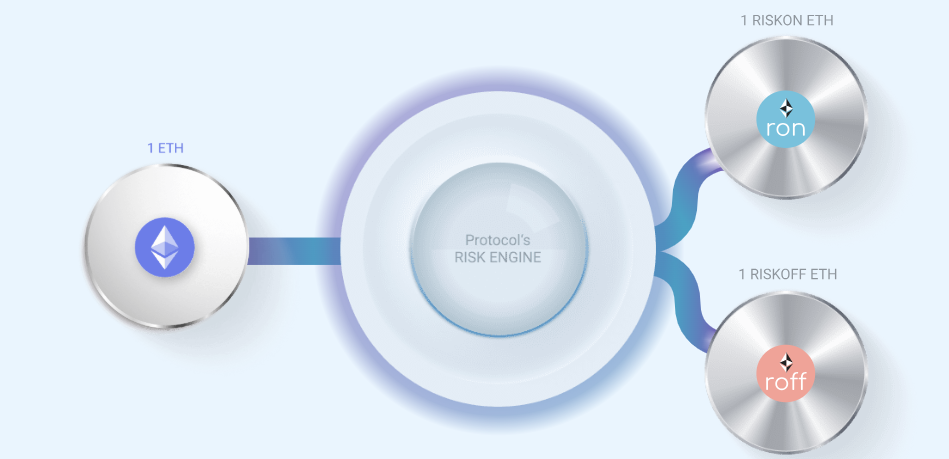
**SMART Tokens** are the core primitive that enables risk-tokenization. We have launched initially with a specific type of SMART Token called **RiskON** & **RiskOFF**. When you deposit an asset as collateral with The Risk Protocol, that asset is split into two complementary tokens—for example, depositing 1 ETH yields 1 RiskON ETH and 1 RiskOFF ETH. These two tokens together always represent the underlying asset’s value, but each one is programmed with a different risk/return profile. They are two halves of the same whole, but with dramatically different behavior. RiskOFF offers stability and downside protection, while RiskON provides leveraged exposure. This is programmable money taken a step further. Our SMART tokens package sophisticated exposures into single tokens so that you can focus on *outcomes*, not *mechanics*.
#### Splitting an Asset Into RiskON & RiskOFF
### Example
Let’s use an example to make this more tangible. Let’s say an investor owns 1 BTC but is uncomfortable with the daily volatility. The investor comes up to TRP, deposits 1 BTC as collateral, and mints 2 new SMART Tokens—RiskON BTC and RiskOFF BTC. RiskON and RiskOFF are designed to have an aggregate value equivalent to the value of the underlying cryptocurrency at all times. The design segregates the risk of owning the underlying cryptocurrency into a *low-risk token* (RiskOFF) and a *levered token* (RiskON). RiskOFF’s returns will generally have less risk in terms of both beta and standard deviation of returns than the underlying cryptocurrency, while RiskON will generally have a beta and standard deviation of returns that exceed those of the underlying cryptocurrency.
How do RiskON and RiskOFF get this profile? By holding synthetic options. RiskOFF is long a down-and-out barrier put that provides a floor, and it is short a call that caps its upside. As a result, it floats within a band and has dramatically lower volatility than the underlying cryptocurrency. Where did it get this exposure from? By contracting with the 2nd SMART token—RiskON. RiskON is the counterparty to all the options that RiskOFF owns. The simple contract between RiskON and RiskOFF is that in return for providing the downside protection to RiskOFF, RiskON gets RiskOFF’s share of the upside beyond the cap. Both initially start out with equal ownership of the underlying collateral and have equal values at the outset. Over time, however, as the underlying BTC moves, their values diverge. If BTC runs up, RiskON will outperform BTC because of the leverage it is getting from RiskOFF, and similarly, in a declining market, RiskOFF will outperform BTC because of the downside protection it is getting from RiskON.
What we have effectively done is that from one asset, we have synthetically extracted 2 different “*risk flavors*” of that asset, designed to appeal to investors/traders with different risk appetites. Investors who want some leverage without margin calls or liquidations will swap out of the RiskOFF token in the secondary market and keep the RiskON. Conversely, if the investor wants risk-reduced exposure to the underlying, they will hold RiskOFF.
Further details on our SMART Tokens can be found in subsequent sections of the documentation.
---
# Agent Instructions
This documentation is published with GitBook. GitBook is the documentation platform designed so that both humans and AI agents can read, navigate, and reason over technical content effectively. Learn more at gitbook.com.
## Querying This Documentation
If you need additional information that is not directly available in this page, you can query the documentation dynamically by asking a question.
Perform an HTTP GET request on the current page URL with the `ask` query parameter, and the optional `goal` query parameter:
```
GET https://docs.riskprotocol.io/overview/how.md?ask=&goal=
```
`ask` is the immediate question: it should be specific, self-contained, and written in natural language.
`goal` is optional and describes the broader end goal you are ultimately trying to accomplish on behalf of the user. GitBook uses it to tailor the answer towards what is most useful for that goal.
The response will contain a direct answer to the question and relevant excerpts and sources from the documentation.
Use this mechanism when the answer is not explicitly present in the current page, you need clarification or additional context, or you want to retrieve related documentation sections.